
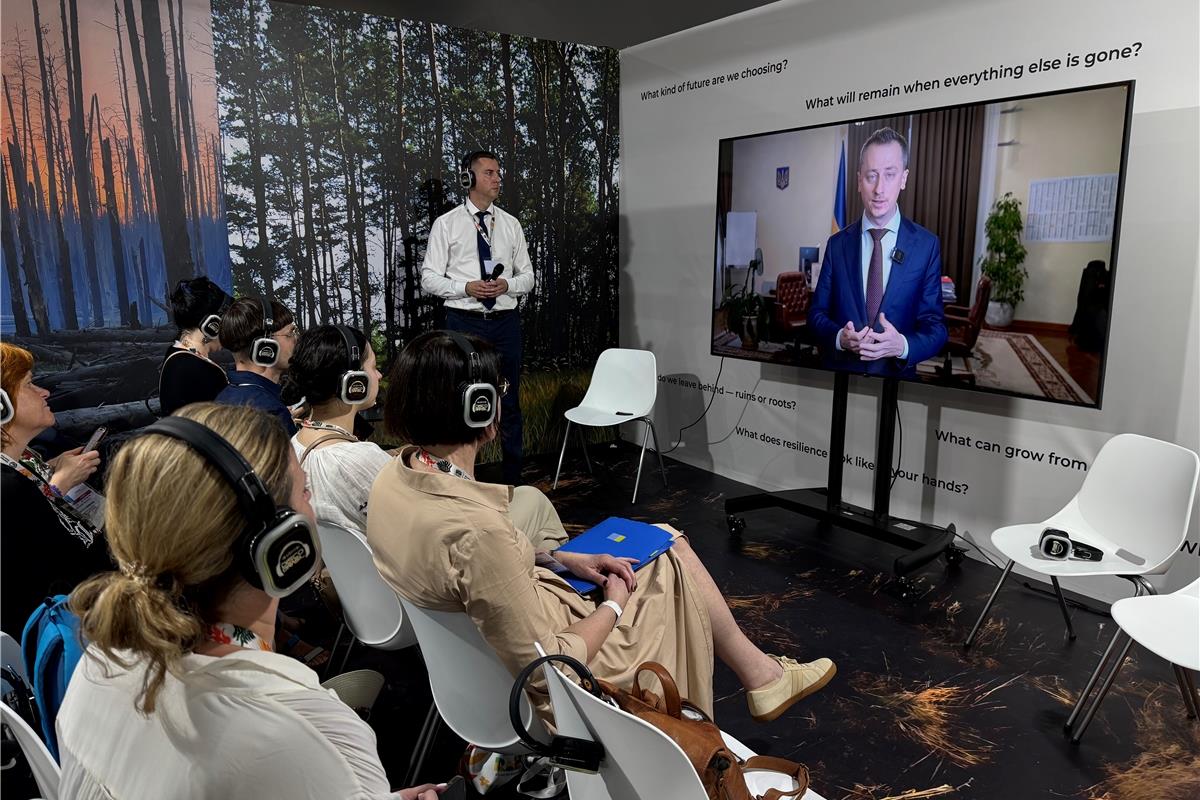
A panel discussion entitled ‘Ukraine’s forestry sector: recovery and sustainability in times of climate change and war’ was held in the Ukrainian pavilion at the UN Climate Change Conference COP30 in Brazil.
“Full-scale war has brought unprecedented challenges to our forestry sector: fires, mines, unexploded ordnance, soil degradation in combat zones. However, Ukraine continues to integrate advanced international experience into its strategic framework for forestry recovery. Forests are vital not only for carbon sequestration and biodiversity conservation, but also for the sustainable development of local communities and the building of a sustainable green economy,” emphasised Oleksiy Sobolev, Minister of Economy, Environment and Agriculture of Ukraine, in his welcoming speech.
The event was attended by representatives of the Brazilian Institute of the Environment and Renewable Natural Resources, the German Federal Ministry of Food and Agriculture, the Swedish Ministry of Climate and Industry, experts from the World Bank, the Directorate-General for Environment (European Commission) and other specialists.
Representatives of the Ministry of Economy, Environment and Agriculture of Ukraine and the State Forestry Agency told international partners about the consequences of Russian aggression for Ukrainian forests:
- 1 million hectares of forests are temporarily occupied
- up to 500,000 hectares are mined or contaminated with explosive objects
- and another 100,000 hectares are in the combat zone.
In total, approximately 3 million hectares of Ukrainian forests have been negatively affected by the full-scale invasion, and the area of forests where economic activity can be carried out has been reduced by 20%.
During the panel discussion ‘Ukraine’s forestry sector: recovery and sustainability in times of climate change and war,’ the Ukrainian side presented the results of forestry reforms to its international colleagues:
the creation of a digital timber traceability chain (e-logging ticket, a consignment note with photo documentation of harvested timber, an e-certificate of origin for timber, and an electronic timber accounting system (EOD)),
the separation of management and economic functions,
and the introduction of transparent timber sales on exchanges.
While in 2014 all enterprises in the industry paid $127 million to the budget, in the first half of 2025 alone, they paid $132 million, despite a 20% reduction in resources.
At the same time, the presence of landmines in forests remains a significant problem. That is why the Ukrainian delegation called on international partners to join demining projects. In particular, through the supply of armoured logging machines — remote-controlled harvesters that can safely operate in mined areas and speed up the process of clearing territories.
The panel discussion ended with international partners highly praising Ukraine’s efforts to preserve and restore forests in the extremely difficult conditions of full-scale war and its confident movement towards European integration.